The Evolution of Streetwear: Fashion Trends Everyone Is Talking About
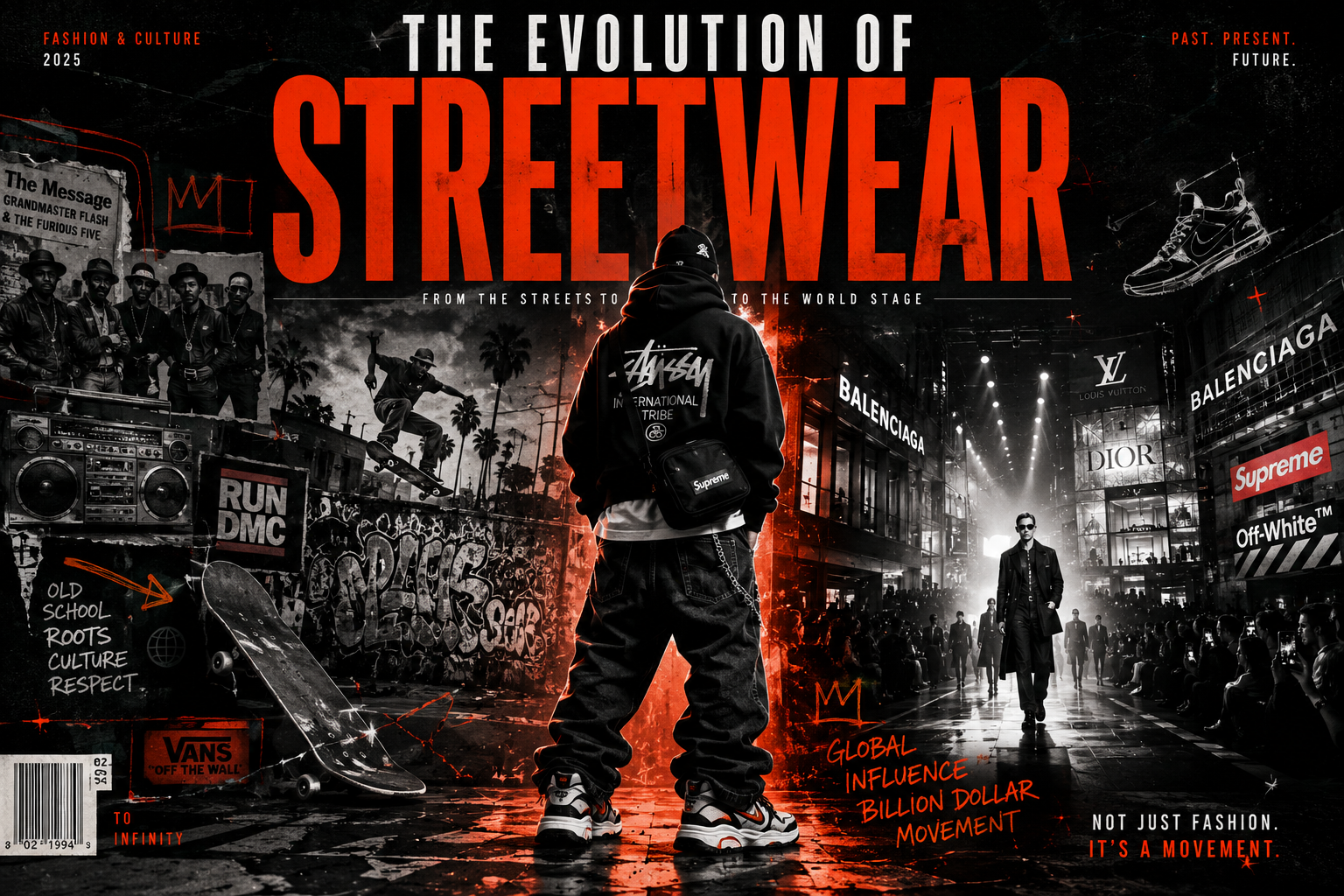
Streetwear didn't start in a design studio. It started on the streets — in skateparks, at hip-hop cyphers, on Venice Beach, and in the Bronx. Real people making real style choices, for real reasons: comfort, identity, belonging, and rebellion.
Today, streetwear is a global industry worth over $185 billion. Supreme sells out in seconds. Nike x Off-White collabs go viral. Balenciaga puts Crocs on the runway. But to understand where it's going, you need to know where it came from.
"Street fashion perfectly blends effortless comfort with limitless self-expression."
Unlike traditional fashion, streetwear doesn't follow seasonal rules or top-down trends. It's driven by subcultures — skaters, hip-hop artists, surfers, and gamers — who wear what works for their life, not what a runway dictates. It's also dissolved gender norms: most iconic streetwear pieces are designed to be worn by anyone.
The roots of streetwear trace back to two parallel worlds in 1970s–80s America: the skateboarding scene in Southern California, and hip-hop culture rising out of New York City.
Skaters needed durable, flexible clothing built to survive falls. They gravitated toward Vans slip-ons, baggy jeans, and graphic tees. Meanwhile in New York, Run-DMC were wearing Adidas tracksuits and shell-toe sneakers on stage — and millions of fans copied that look down to the last unlaced lace.
In the late 1980s, Shawn Stüssy started selling screen-printed T-shirts out of his car in Laguna Beach. Stüssy became the first brand to deliberately fuse surf, skate, and hip-hop aesthetics — creating the template that every streetwear brand since has followed.
By the 1990s, the movement had its own infrastructure: limited drops, brand loyalty, a resale economy, and a culture of collecting. Supreme opened its Lafayette Street store in 1994. The blueprint was set.
Denim
Baggy Jeans
Born in the 1980s and '90s through skate and hip-hop subcultures, baggy jeans were never "just fashion." They were a uniform — a statement that said: I don't care about your dress code.
After years of skinny jeans dominating, baggy denim is back. The key to nailing the look: balance oversized denim with a fitted top and chunky footwear. Don't stack the volume on both halves.
Tops
Oversized Hoodies
The oversized hoodie is Gen Z's uniform. It's comfortable, low-effort, and quietly anti-normative — a way of saying "I choose comfort over convention."
The ideal fit has dropped shoulders and a boxy silhouette. Pair with structured bottoms — straight-leg jeans, cargo pants, or biker shorts — to keep proportions intentional rather than accidental.
Bottoms
Cargo Pants
Originally designed as British military wear in the 1930s, cargo pants have had more lives than any garment in streetwear history. Y2K staple → dormant in the 2010s → back harder than ever.
The comeback is driven by a real cultural shift toward utility fashion — clothes that are functional first, stylish second. Multiple pockets, relaxed fit, works for the gym, the commute, or a night out.
Tops
Graphic T-Shirts
The graphic tee is the original wearable media. Before Instagram, people were broadcasting identity through band tees, political slogans, and skate brand logos. It hasn't changed — it's just evolved.
Footwear
Chunky Sneakers
The chunky sneaker went from "dad shoe" meme to high-fashion item faster than most brands can ship a collection. Balenciaga's Triple S, New Balance 550, and ASICS Gel-1130 all prove the same point: exaggerated sole, maximum presence.
What keeps them relevant is the comfort factor. A shoe that looks like it can survive an apocalypse — and actually feels good to walk in? That's streetwear's sweet spot.
Accessories
Crossbody Bags
The crossbody bag solved a problem streetwear always had: you need to carry things, but backpacks are bulky and handbags are formal. Crossbody sits right in the middle — hands-free, compact, stylish. Works with everything from a utility fit to a smart-casual look.
The biggest turning point in streetwear's history wasn't a new brand launching — it was a collaboration. Louis Vuitton x Supreme in 2017 put two worlds that were never supposed to meet into the same collection, and broke the internet doing it.
Virgil Abloh took it further. His work at Off-White and later as Louis Vuitton's Men's Artistic Director proved that streetwear wasn't borrowing credibility from luxury fashion. Luxury was borrowing credibility from the streets.
"Streetwear didn't rise to meet fashion. Fashion descended to meet streetwear."
Today, the line between high fashion and streetwear is effectively gone. Balenciaga does hoodies. Gucci does sneakers. The runway is influenced by TikTok, not the other way around. That's the full circle of streetwear's journey — and it's still moving.
Shop the Look
Find trendy fashion and everyday essentials from trusted sellers. Explore styles that match your personality and budget.
Related products
Subscribe to the Vanguard
Get deep dives into archive fashion and upcoming drops delivered to your radar.